HYPERTROPHY PROGRAMMING: A COMPLETE GUIDE WORKSHOP
Workshop Description and Objectives:
This is a 2-day workshop that covers several key aspects with regards to effectively programing for hypertrophy. The workshop covers basic physiology of how muscles function and the physiological mechanisms underpinning muscle hypertrophy. Participants will also learn how to manipulate key variables such as exercise selection, volume, intensity, frequency, and rest periods based on the client’s performance and goals. Other than that, participants will also be introduced to concepts in the realm of hypertrophy such as time under significant tension, training to failure, stimulating repetitions that will give them a deeper understanding about the science of hypertrophy. Participants will be involved in a hands-on session where they will learn to design programs based on the guidelines and practice some of the exercises in a group setting, to give them a better understanding on how to apply concepts taught.
Course objective:
- Students will be able to develop an effective hypertrophy program based on the key variables in programing
- Students will learn to manipulate the program according to the client’s performance and goals
- Students will be able to explain to their clients the intent behind their programing and what are the vital information that is required during the feedback to allow effective progression of the program and troubleshooting problems.
Course Module
Day 1: Theory
- Module 1: Revisiting skeletal muscle physiology
- Module 2: Understanding the mechanisms that underpin hypertrophy
- Module 3: Variables in programming to maximize hypertrophy
- Module 4: Exercise selection and progression
- Module 5: Designing a sensible hypertrophy program
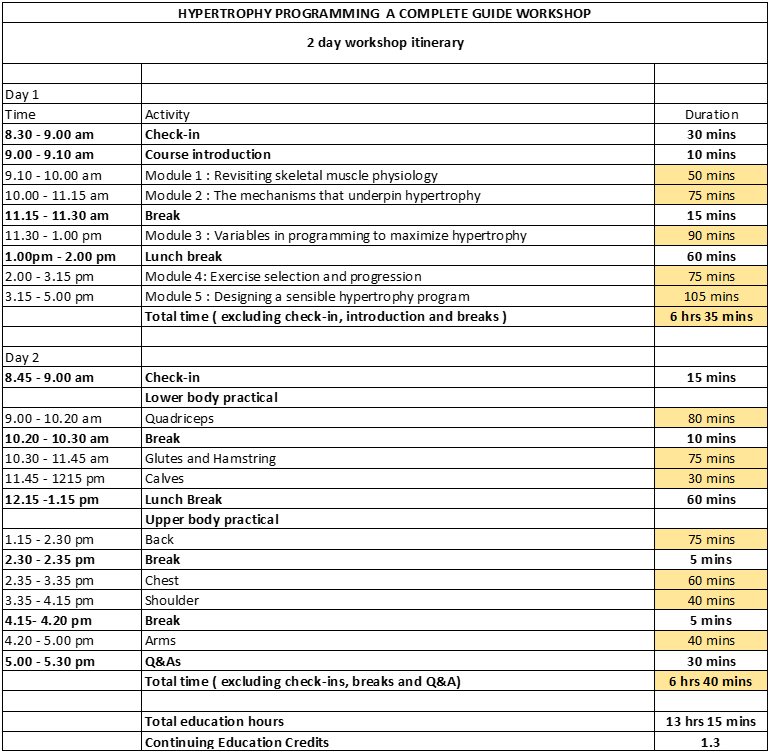
Day 2: Practical
Lower body (9.00 am – 12.15 pm)
Quads and squat varieties (9.00 am to 10.20 am)
- How to execute the smith machine squat, bulgarian split squats and leg press to better target the quads. From setup to execution. Key pointers to execute the movement well.
- Why leg extensions are necessary to get complete quadriceps growth – rectus femoris a muscle that is trained least in squat variety movements.
- Learning how to judge a set difficulty based on Rating of Perceived Exertion.
Hamstrings and glutes (10.30 am – 11.45 am)
- Execution the Romanian deadlift (barbell and dumbbells)
Training the hamstring using long muscle length with hip hinging movements. How is glutes involved in the RDL. How does it differ from stiff legged deadlifts. - What is the difference between the seated and lying leg curl – same muscle but differing emphasis. Discussing about lengthened muscle position.
- Glute bridges – a great way to isolate glutes.
Calves (11.45 am – 12.15 pm)
- How to target the gastrocnemius and soleus with varying setup. Why does the knee flexion angle matter.
Upper body (1.15 pm to 5 pm)
Back (1.15 pm – 2.30 pm)
- Pointers to setup rowing motion to selectively target the rhomboids and mid trapezius. How do hand positions matter on rowing machines. Explaining how choice of exercise may improve the ability to bring targeted muscle towards failure (task vs muscular failure).
- How to setup the lat pulldown or rows to work thoracic, lumbar and iliac fibers better.
Chest (2.35 pm – 3.35 pm)
- Methods to target upper and lower pectoralis with varying bench angles for bench presses.
- Methods to target for upper and lower pec bias on cable flyes.
Shoulder (3.35 pm – 4.15 pm)
- How to improve the setup on the shoulder press both with dumbbells and smith machines – make pressing safe.
- How to optimize the setup for a lateral raise with both dumbbells and cables. Why scapula motion should be accounted for.
- Rear delt exercises – a forgotten muscle.
Arm (4.20 – 5.00 pm)
- Triceps – targeting the long head, medial and lateral heads better with 2 different setups for triceps extensions.
Biceps and brachialis – How to perform the hammer curl right. - How to setup to bias the short head and long head of biceps brachii.
- Explaining how the setup helps addressing the long biceps and triceps which are biarticular muscles.
- Utilizing drop sets, myoreps and supersets
Q&A session (5.00 – 5.30pm)
Who will benefit?
- Fitness trainers
- Strength and Conditioning Professionals
- Physiotherapist
- Fitness Enthusiast of at least 6 months experience
Course Provider
- Dr. Triton Coaching
CEC Points
- ACE 1.3 CECs, NASM 1.3 CEUs
Course Duration
- 13 hours 15 Mins (Educational hours)
Materials provided
- Slides to registered participants
- Water
Certificates
- Certificates will be provided to all participants that complete both days of the course.
Exams
- N/A
Attire
- Fitness attire
Things to bring
- Stationery
- Spare clothing for day 2
Language
- English
Course capacity
- Minimum capacity 8 and maximum capacity of 15
All information provided is accurate at the point of publication. It is subject to change in the future at Dr. Triton Coaching discretion.
 Dr.Triton Coaching